
Last year I got to do something I’d wanted to do for a long time. I was able to sit on my first author panel, in New Orleans, talking about true crime in fiction. Between sessions I did what I always do in a new city: I went looking for houses. The French Quarter obliges. My daughters and I ended up on Royal Street, among other tourists with their phones out, all of us admiring the same wrought-iron balcony. It isn’t abandoned exactly, but its history is anything but ordinary.
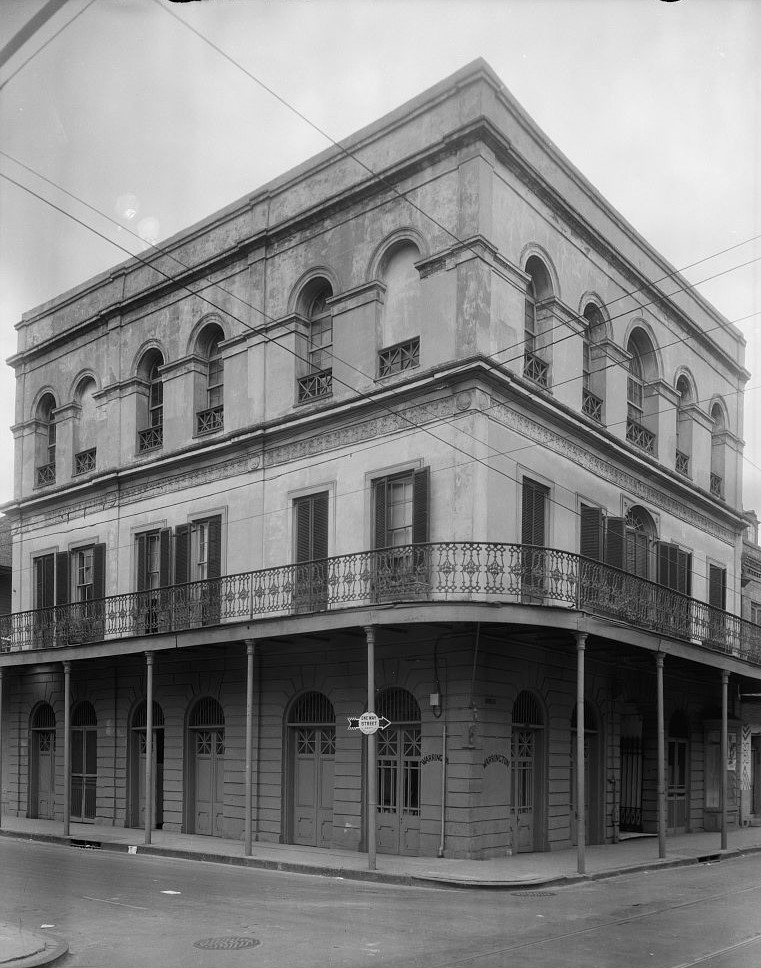
Historic 1937 photograph of the LaLaurie Mansion on Royal Street, from the Library of Congress’s Carnegie Survey of the Architecture of the South.
That was the LaLaurie Mansion. Standing in front of it was different. It’s just a house. Cream stucco, tall shuttered windows, a corner lot at Royal and Governor Nicholls that any of my characters would be lucky to inherit. Nothing about the outside tells you what happened inside it. That gap, between how ordinary a place looks and how much horror it can hold, is the whole reason I can’t stop writing about houses with a not-so-nice history.
Madame Delphine LaLaurie was, by every account before 1834, one of New Orleans’s most admired hostesses. Born Marie Delphine Macarty in 1787 to one of the city’s oldest Creole families, she’d already survived two marriages by the time she reached her forties. In 1832, she married her third husband, Dr. Leonard Louis Nicolas LaLaurie, and moved into the mansion at 1140 Royal Street. She threw parties there. Everyone wanted to be invited.
The Fire That Exposed Everything
On the morning of April 10, 1834, a fire broke out in the mansion’s kitchen. The story that’s held up best over nearly two centuries is that the cook, an enslaved woman chained to the stove, started it deliberately, a last, desperate bid to bring help into a house no one outside it was allowed to see.
It worked. When neighbors and firefighters broke through a barred door on the upper floor, they found seven enslaved people chained inside, starved and mutilated, some restrained in ways designed to keep them alive but broken. The New Orleans Bee reported it plainly the next day: seven slaves, “more or less horribly mutilated.” It wasn’t the fire that made the LaLaurie house famous. It was what the fire made impossible to keep hidden.
It also wasn’t the first sign. A year earlier, neighbors said Delphine had chased a young enslaved girl through the house with a whip until the girl fell from the roof and died; the body turned up buried in a well on the property. At the time, that story circulated and mostly went nowhere. The fire is what finally forced people to start looking.
News spread through the Quarter within hours, and a mob gathered outside the mansion. Unable to reach Delphine and her husband, they tore the inside of the house apart instead: furniture smashed, walls stripped, the physical proof of what had happened destroyed along with everything else. By then the LaLauries were already gone. Their carriage reportedly made it to Lake Pontchartrain, where they boarded a schooner north, and eventually crossed to Paris. No trial ever happened. Delphine died there in 1849 and was buried at Cimetière de Montmartre; more than a century of local lore insists her remains eventually made their way back to St. Louis Cemetery No. 1, just blocks from the house she fled.
A House That Kept Changing Hands, Never Its Reputation
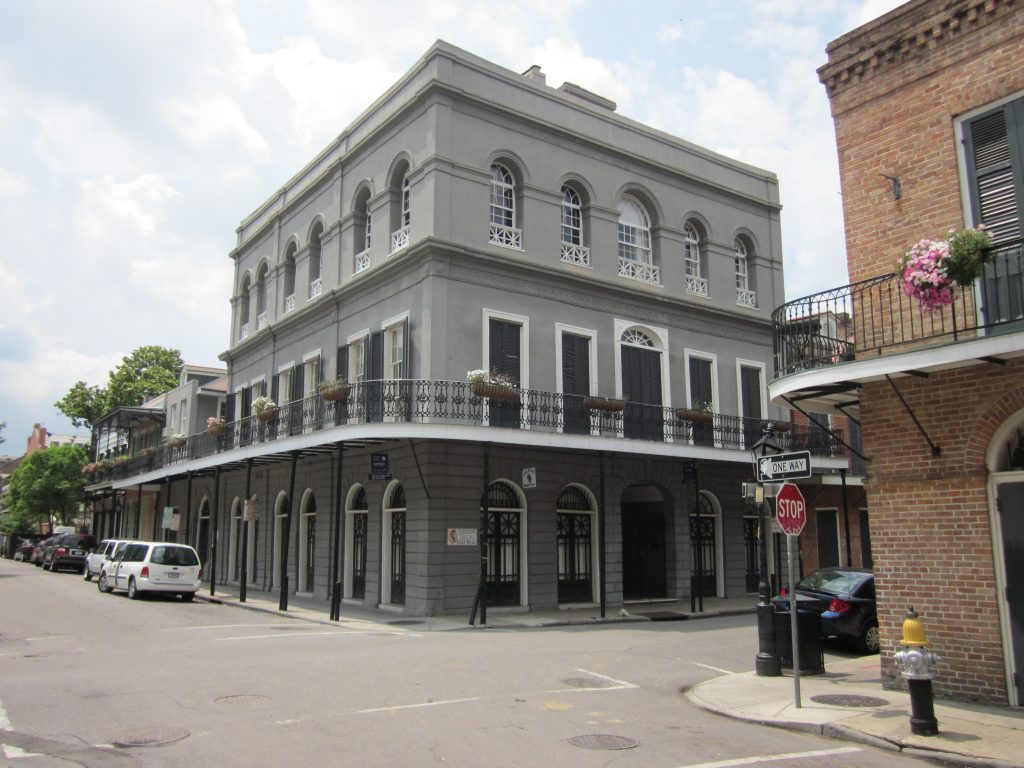
The LaLaurie Mansion at 1140 Royal Street in New Orleans’ French Quarter,
What’s strange about the LaLaurie Mansion isn’t that it survived. It’s what it survived into. After the mob gutted it, the house sat damaged for years before it was repaired and pressed into a string of ordinary, almost defiantly unhaunted uses: a school in the years after the Civil War, later a conservatory of music, later still cut up into apartments that housed waves of immigrants in a city that gave them nowhere else to go. By the twentieth century it had cycled through as a furniture store and a bar before finally settling back into what it started as: a very expensive private home in the French Quarter. Like the secrets in my own stories, including the secrets in my next novel, this one didn’t disappear. It just kept finding a new place to hide.
Nicolas Cage bought it in 2007, on record as being drawn to the macabre reputation as much as the address, and lost it to foreclosure two years later. It changed hands twice more since, and as of a recent listing, it’s back on the market in the neighborhood of ten million dollars. People keep buying a house that’s never stopped being famous for the worst thing that ever happened inside it.
That’s the detail I carried out of New Orleans, more than the ghost stories the tour guides sell on Royal Street every night. A house doesn’t have to fall down to be a monument to something terrible. Sometimes it just keeps getting a fresh coat of paint and a new owner willing to live with what the walls already know.
I’m still early into drafting Book 3 (Where Secrets End, Feb. 2, 2027) of The Secrets Trilogy, but I already know a house with a backstory this twisted is going to end up in it: a place that looks innocent on the outside, but never quite lets go of what it did to the people it once owned. New Orleans has no shortage of houses like that. I have a feeling I’ll be back.
Until next time, remember: the abandoned still has a story to tell. You just can’t be afraid to dig it up.
Want to know when I track down the next one? Sign up for my email list and I’ll send you the first chapter of Where Secrets Stay free, the novel that started as one of these house obsessions.